
Ahead of official-level consultations in Washington on the Indo-American nuclear deal, Prime Minister Manmohan Singh Wednesday said it was for the United States to decide on taking the agreement forward.
Uncertainty over the Indo-US nuclear deal cast a shadow over the first Indo-French nuclear business meet in Mumbai, which was aimed at strengthening bilateral cooperation in the atomic field.
The PMO issued a press release virtually repeating its earlier assurances that the deal did not undermine India's nuclear sovereignty or did any harm to the country's interest. At a press conference later, Singh said the prime minister should come out with a public statement either in Parliament or outside assuaging their concerns as they were not in a position to support the deal as of now.
'If there is a military standoff eyeball to eyeball on the western border, the Chinese could create problems by making movements in the north, in our northeast, which could involve us tying down some forces there so that could stretch our military actions.'

'Nothing in the deal required the US Congress to pass legislation in a single step,' says Dr Michael A Levi, nuclear expert.
Pak approaches NSG for a nuclear deal similar to the US-India one
"India is supposed to get only uranium for its nuclear programme to expand. Simply for this, so much compromising... is uncalled for," he said.
What does the prime minister's position on the nuclear deal mean? What does the Congress want from the issue? What does the Left stand to gain? Sheela Bhatt explains.

The Congress will take on the government in Parliament on the Indo-US nuclear deal
The United States on Monday indicated that it is favourably inclined to the civilian nuclear deal between China and Pakistan, but it should be in compliance with the rules of Nuclear Suppliers Group.
Queried whether opposition from some sections in America to the deal stemmed from concerns that India could be a proliferator, Neureiter said, "I have not sensed anything like that."
Officials are stressing that the civilian nuclear deal is only one part of the US-India cooperation and the success of a Presidential visit ought not to be pegged on this one aspect.

'Putin dreams about his legacy. He wants to forcibly restore the Russian empire.' 'Unfortunately, after three years of large-scale war with massive human losses, Putin will not budge from his goal because human life is the cheapest resource in the Russian State.'
The Left's plan is clear. It will allow the government to go to Vienna to ink the agreement only after ensuring that the deal with the US is not possible.
A range of regional and international issues were discussed during the 30-minute meeting Senators Russel D Feingold and Robert P Casey Jr held with Mukherjee. Asked whether the nuclear agreement came up during the deliberations, Feingold said the two sides discussed a wide range of issues including the deal.
The two deliberated on how to go about in implementing the agreement, with the US Ambassador emphasising the need for taking the next steps as early as possible as delay could endanger the agreement

After the 1962 War with China, there was a demand to forge greater defence cooperation between India and the West. One such voice was that of Sudhir Ghosh, a distinguished MP, to tie up strategic cooperation with the USA immediately after the Chinese attack on India, recalls Rup Narayan Das.
The Indian Diaspora has been able to carve a niche in their adopted countries as a result of their talent, perseverance and hardworking nature, asserts Rup Narayan Das.
It would be an epic waste if India lets go off the opportunities, including the end to nuclear isolation, thrown open by the civil nuclear deal with the US, feels Finance Minister P Chidambaram.
He hoped that relations between the two countries will not be adversely affected if the Indo-US civil nuclear deal does not go through the American Congressional processes.
Describing the deal as a "symbol" of what India and the US could do in the future, US Assistant Secretary of State Richard Boucher, however, said a lot of "hard work" was left to be done.
With the government emerging victorious in the confidence motion, the country would be signing the civilian nuclear deal with the US which has the potential to significantly boost India's nuclear energy production, says a report by Moody's economy.com.
The NPT expert also said the US was speaking on both sides of its mouth on nuclear non-proliferation.
'The deal on offer creates a Tarapur-style trap of gigantic dimensions. In fact, the latest Act specifically empowers the US to do what it did in 1978 -- retroactively rewrite the rules of cooperation with India by enacting a new domestic law.'
Manufacturers view the agreement - when it is signed - as a defence against the slowdown in the car market.

'You don't need massive industry or huge energy resources.' 'You could start with just 3 or 4 people in a coffee shop and invent the world.'

Prime Minister Manmohan Singh should meet United States President George W Bush in Washington next week but he should not sign the Indo-US civil nuclear agreement, according to Lalit Mansingh, former ambassador to the US and a staunch supporter of the nuclear deal.
Pakistan has reportedly entered into a civil nuclear deal with China for setting up two nuclear power stations of 640 megawatts in Chashma.
The PM is making a long-awaited statement in the Rajya Sabha.
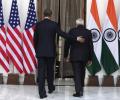
"Prudence and caution" needs to be exercised, warns China.
Notwithstanding the resolution of G-8 countries on curbing transfer of enrichment and reprocessing technology, India on Thursday asserted that it was proceeding with bilateral civil nuclear deals with various countries on the basis of 'clean waiver' granted by the Nuclear Suppliers Group.

Presenting the Union Budget, Sitharaman announced that the government will partner with the private sector to set up Bharat Small Reactors and in the research and development of small modular reactors.
India has received the first consignment of 60 tonnes of uranium from France for use as fuel to power its nuclear reactors following clearance by the 45-nation Nuclear Suppliers Group
Prime Minister Manmohan Singh on Monday thanked US lawmakers for their enormous support to the historic civilian nuclear deal, which was signed between India and the United States last year, thus ending decades of nuclear apartheid against New Delhi.
Pakistan Prime Minister Yousuf Raza Gilani has demanded from the US a nuclear deal similar to the one Washington has made with India, assuring that the nuclear proliferation network of its scientist A Q Khan was broken and will not be repeated.

"They (Iranians) are the number one terrorist state. They're sending money all over the place -- and weapons. And can't do that," Trump told Fox News in an interview telecast during the Super Bowl tournament.

Canadian Prime Minister Stephen Harper has expressed confidence about concluding a civil nuclear deal with India within weeks, asserting that prejudices of the past would not be allowed to come in the way. "We were anxious to conclude the agreement. But there is still some amount of work to be done," Harper, who held talks with Prime Minister Manmohan Singh on Tuesday, told television channel NDTV.
As uncertainty over the fate of the civil nuclear deal continues, the United States has said the pact is likely to clear the hurdles at International Atomic Energy Agency and the Nuclear Suppliers' Group, but the 'main stumbling block' is the internal political process in India. "If the Indian government approves it, I do think that then what remains is to get an agreement with the IAEA and with the NSG. But I think those things are definitely feasible." John Negroponte said.
